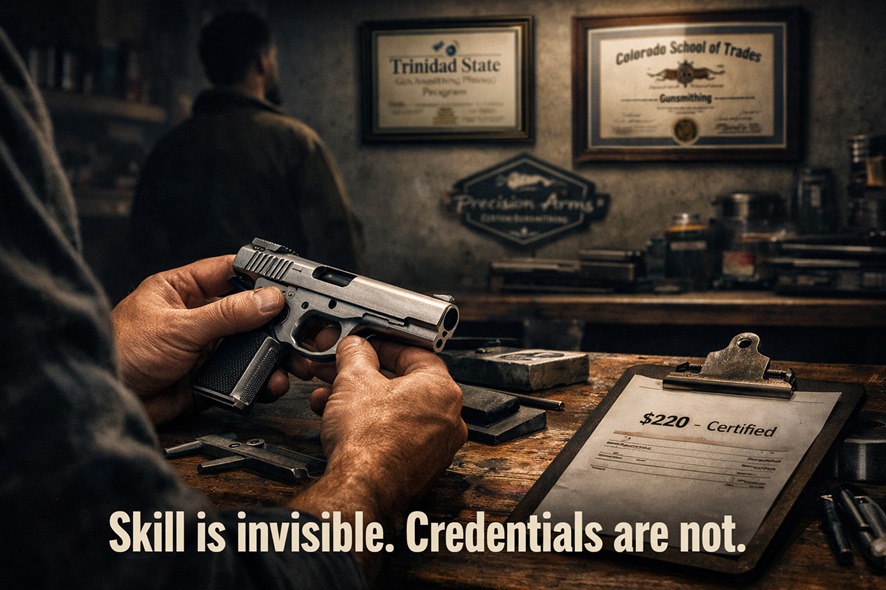
There is a gunsmith working out of a converted garage somewhere in the Midwest who can fit and finish a 1911 better than most shops charging twice his rate. His work is clean. His timing is right. His customers know it. And he is still losing out to a credentialed graduate two counties over who, on a good day, produces slightly inferior work.
This is not a story about fairness. Fairness is not the operating variable. The market is.
Ask yourself whether a Harvard Law graduate can charge more than a graduate of a regional state school. Of course she can. Does the Harvard lawyer win more cases? The data says no, But the client sitting across the desk doesn’t have the tools to evaluate that. What the client knows is the name on the diploma. The credential removes uncertainty at the moment of decision. That is a function skill alone cannot perform.
The same dynamic plays out at the bench every day. And in this trade, it has a dollar amount attached to it.
Two smiths quote the same trigger job on a carry pistol. One has a diploma from Trinidad State College or Colorado School of Trades on the wall. Programs the industry has respected for decades. Brick-and-mortar. Hands-on. The other is self-taught, works clean, and would likely produce equal results. The credentialed smith quotes $220. The self-taught smith quotes $160. In many cases, the credentialed smith wins the bid. The customer isn’t paying for better work. He’s paying to eliminate the risk of being wrong.
Trinidad. Colorado School of Trades. Murray State. These are the programs that function the way Harvard functions for the law firm partner choosing outside counsel. Not as a guarantee of output quality. As a risk reducer. The client isn’t just buying the work. He’s buying confidence that he made a defensible choice.
"Every month a smith spends without a recognized credential is a month spent competing on reputation alone, in a market that increasingly defaults to institutional trust."
Now. Here’s what the credential theory doesn’t explain. And it deserves honest treatment.
There are gunsmiths in this country whose names are the credential. Not a piece of paper behind them. The name itself.
Bill Wilson started in the back room of his father’s jewelry store in Berryville, Arkansas, in 1977. No gunsmithing school diploma. A competitive shooter with fine motor skills and a precision mindset borrowed from watch repair, and an obsession with making 1911s work better than they left the factory. Forty-five years later, Wilson Combat employs over 200 people across three states. When a customer commissions a Wilson Combat pistol, he isn’t asking about credentials. The name is the credential. It was built through decades of championship shooting, documented performance, and work that spoke loudly enough to make the institutional question irrelevant.
Doug Turnbull started the same way. Back room of a gun shop in Bloomfield, New York, 1983. The credential Turnbull carries now is not a certificate. It is thirty-five years of bone charcoal color case hardening work so precise, so historically faithful, that major manufacturers send him work. Multi-year waitlists. Clients who describe the finished product as too beautiful to shoot. Turnbull didn’t transcend the credential system by ignoring it. He rendered it irrelevant by producing work that became its own standard.
The ACGG Professional Membership operates on the same principle at a formal level. You cannot simply apply. You serve as an associate for a minimum of one year, then submit your work for judgment by a quorum of professional members at the annual show. They vote on it. If the work meets the standard, you earn the designation. No course. No test. A verdict rendered by the people who know what exceptional looks like. When an ACGG Professional member puts that affiliation on his shop door, he is not citing something he completed. He is citing something the trade decided about his work.
These are the exceptions. They are real. And they are worth naming honestly.
But here is the part worth sitting with. Wilson’s credential took forty-five years to build. Turnbull’s took thirty-five. The ACGG requires demonstrated mastery sufficient to survive peer review by the best craftsmen in the country. These men didn’t skip the credentialing process. They built credentials that happen to look different, and they did it over careers, not years.
Skill without credential is a ceiling. At the apex of this trade, the ceiling disappears. Getting to the apex is the work of a lifetime.
The practical consequence for anyone who is not already operating at that level is straightforward. A smith with a verifiable credential from a recognized institution can defensibly price above the market baseline. Not necessarily because the work is better, but because the customer’s cost of uncertainty is lower. The smiths operating at the highest tier below the apex are stacking signals. The baseline is a recognized school credential. On top of that, platform-specific armorer certifications from manufacturers add visible, searchable proof of competence in high-demand niches. Published work converts private expertise into public authority. And for those whose work genuinely qualifies, ACGG membership closes the conversation entirely.
None of these require abandoning the bench. They are accumulated over time, with intention. The smith who assumes the market will eventually find his skill is betting on an outcome the market has shown, repeatedly, that it will not deliver.
The trades have always had this tension. The master carpenter who learned from his father and the journeyman who came up through the union both know how to drive a nail. The union card gets the bid. This is not new information.
The YouTube dude is not your competition because his work is better than yours. He is your competition because the customer cannot tell the difference before the job is done. The credential is the mechanism by which you make that distinction legible before the trigger is pulled.
If the market can’t see your skill, it doesn’t exist.
Build the signal. The bench will pay you for it.