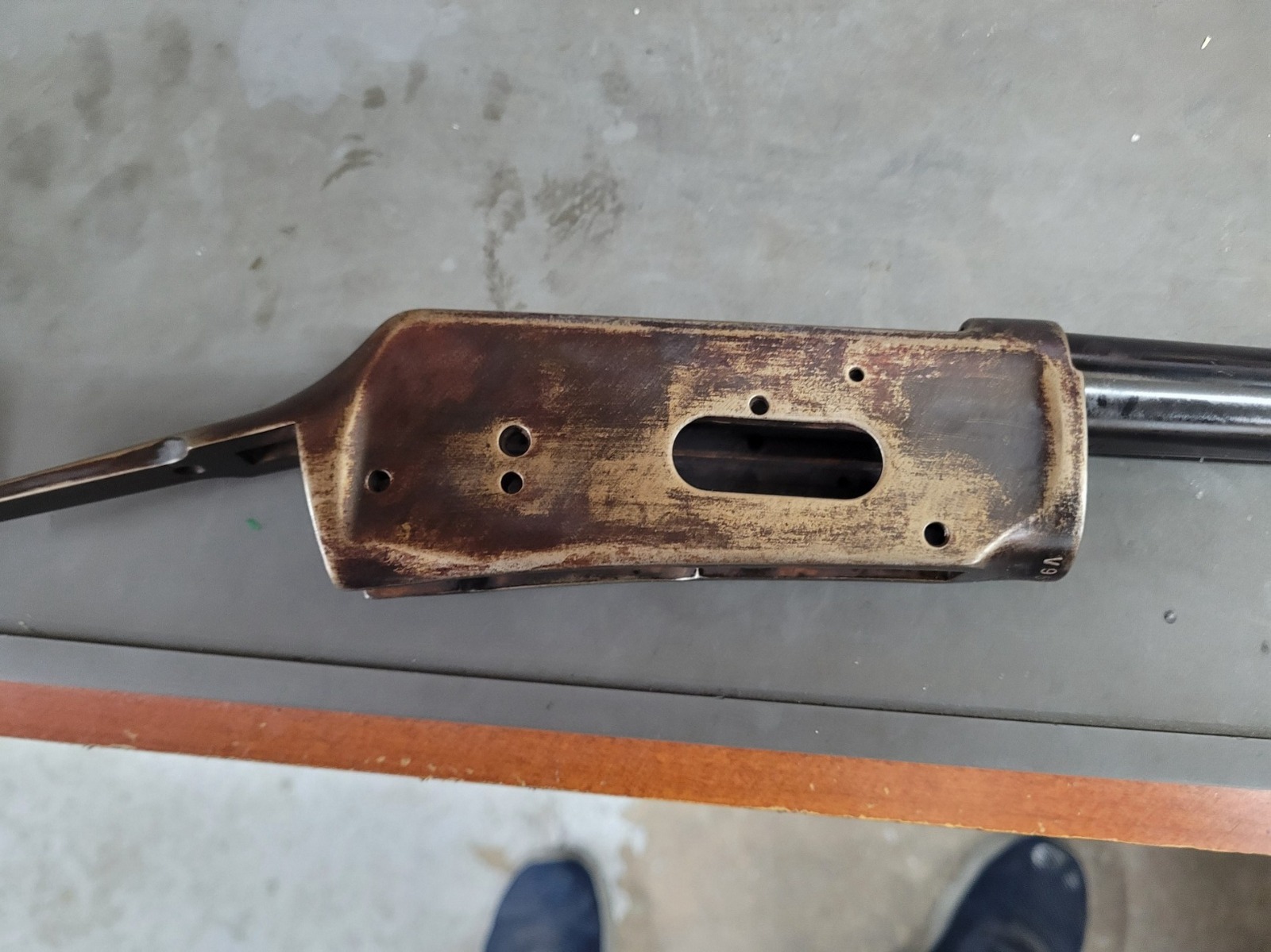
Every gunsmith who does bluing long enough eventually meets the job that fights back. You can do everything right. Temperature holds. Chemistry is fresh. Polish is as good as you know how to make it. You pull the part out of the tank and it looks back at you like you’re not welcome.
For me, that job has a name: Winchester post-1964.
If you’ve done bluing work for any length of time, you already know the reputation. The Winchester Model 94 changed significantly after 1964 when the company moved to more cost-efficient manufacturing processes. What changed along with the production methods was the metallurgy of the receiver, and what that change did to the steel’s relationship with a caustic bluing tank is the kind of thing that doesn’t show up in any manual. You learn it by losing hours to it.
The first time I ran one, I didn’t know what I was in for. The customer had a post-’64 lever gun, sentimental value, wanted it looking right again. The metal on the barrel and the other parts polished out fine. The receiver came up looking decent under prep. I ran the whole package through together.
The barrel came out clean. The receiver came out wrong.
Not visibly failed. Not so bad the customer would necessarily have caught it at pickup. But wrong in the way that a bluer knows: uneven uptake, a surface that looked almost oily in the wrong light, no depth to the finish. I put it back in. I adjusted temperature. I extended the cycle. I pulled it again.
Still wrong.
"Their metallurgy is horribly resistant to rebluing no matter what you do. Even after hours of degreasing and polishing and gobs of time in the heat bluing tank, sometimes it’s just not gonna happen."
I have since talked to other gunsmiths who do bluing work and the Winchester post-’64 receiver is among the most universally dreaded pieces in the rebluing trade. Some shops turn the job away at intake. Others will blue everything except the receiver and send it out for Cerakote in matte black, matching it as close as possible to the parts that came out right. That is usually the honest answer when the customer wants a dark uniform finish and the receiver won’t cooperate.
What I learned from that first fight, and from the ones that came after it, is that knowing the steel is part of the job. Not every metal wants the same process. The Winchester receiver is only the example; the real lesson is that every finishing process has materials it serves well and materials it should not be forced onto. Bluing is a chemical reaction with the iron in the steel, and if the alloy composition is off from what the process expects, the reaction will be off too. You can’t brute-force chemistry. You can extend the time and raise the temperature and try again, but at some point the steel is telling you something and the professional move is to hear it.
There is also a customer conversation that comes with this. When I take in a post-’64 Winchester for bluing now, I tell them upfront what they’re dealing with. The barrel and the smaller parts will take the blue. The receiver may not cooperate, and if it doesn’t, here are the options. Most customers who have done any research appreciate the honesty. The ones who haven’t done any research need to hear it before the work starts, not after.
"Many gunsmiths turn the job away at intake. That is not a failure of skill. It is a skill"
Turning a job away is not a failure of skill. Knowing which jobs to turn away is a skill. The gunsmith who takes in every post-’64 Winchester without that conversation is setting himself up for a result he can’t fully control, and a customer conversation he definitely doesn’t want. The gunsmith who knows the steel, names the risk, and presents honest options walks out of that interaction with his reputation intact regardless of which way the job goes.
I still take some of those receivers in. Sometimes they surprise me in a good way, especially on guns that sat unfired and stored well, where the surface hasn’t been through years of oxidation cycles. When one comes out right it is satisfying in a specific way that easier jobs are not. But I go in knowing it might not, and the customer goes in knowing it too.
That conversation is part of the job. The steel always has a vote. The gunsmith’s job is to know that before the customer drops it off.