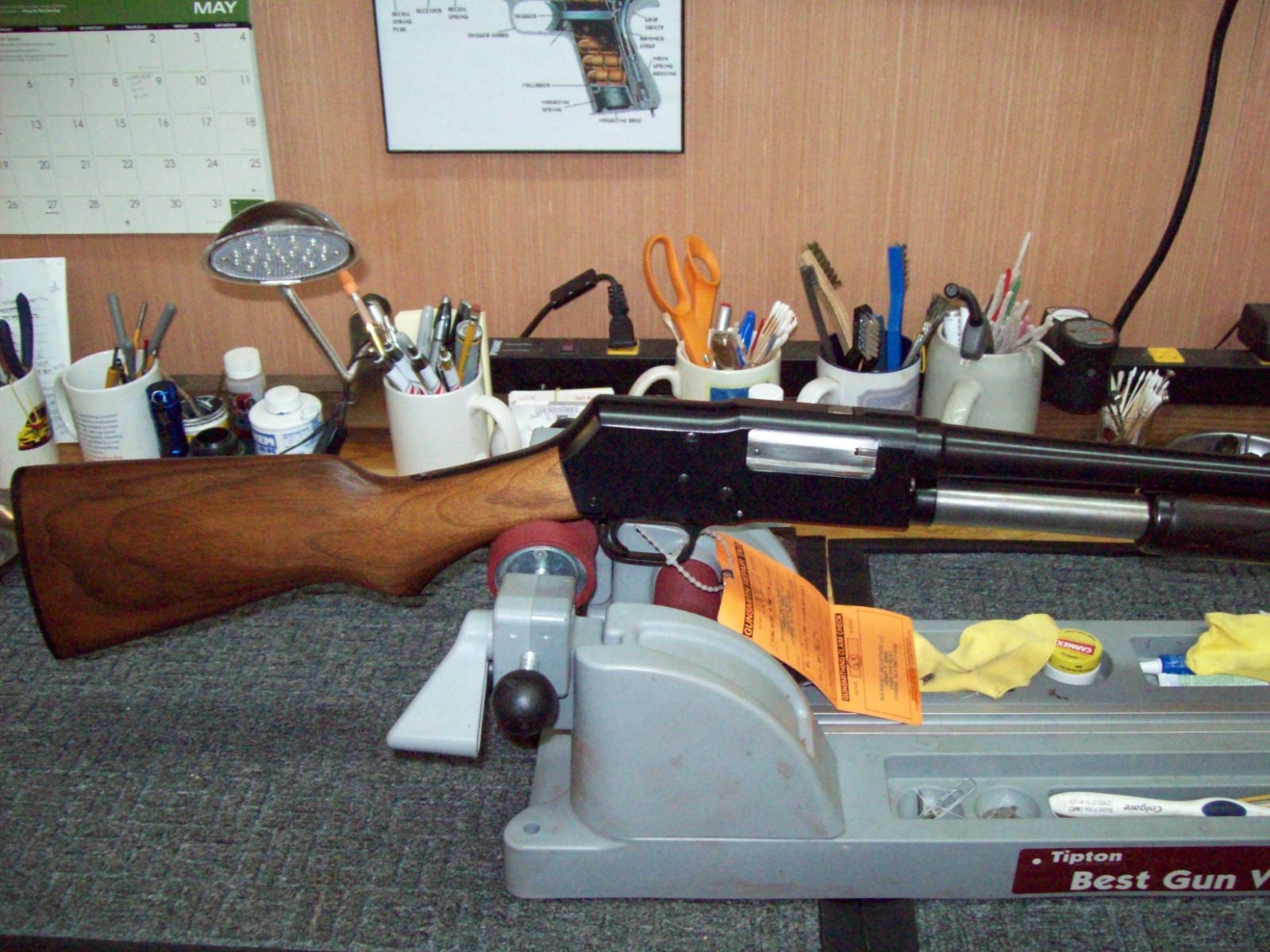
I had put in the hours. Endless hours of stripping and polishing, getting my caustic bluing operation up and running from nothing. Anybody who has built a bluing line from scratch knows what those early months cost: bad tanks, ruined test pieces, chemistry that didn’t behave the way the books said it would. When that first job came off the tank, I knew I had something.
It came out phenomenally. Deep, even, black as a winter night, with that glass-like finish you only get when the polish underneath is right and the tank temperature holds steady the whole cycle. I set it on the bench and took several photos. I couldn’t wait for the customer to see it.
The workspace around that bench told its own story. Stripping tanks on one side, rinse stations in the middle, the bluing line itself running along the back wall, and bottles of remover acid staked out wherever there was a free inch of counter. That is how most one-man bluing shops look in year one. You build the process before you build the habits that keep the process safe.
I was putting everything away when I knocked over a bottle of bluing remover acid. Half-closed cap. It splashed straight across the finished work.
I stripped it down and did it again. The customer got the work he paid for.
I blued it twice. Got paid once. ’Nuff said.
That second run was not just extra labor. It was lost time, wasted materials, and a reminder that the last five minutes of a job can ruin everything that came before it. Strip solution, neutralizer, polish compound, shop time twice over none of that gets billed back to the customer when the mistake is yours. The piece was finished. The hard part was done. That was when I let my guard down.
"Keep your bench clear of anything that can damage your work if you’re not using it: acids, tools, excess parts, anything. It was a hard lesson learned."
The lesson isn’t complicated. It doesn’t require a system or a checklist. It requires a clear bench
When work reaches the finished stage, the bench changes. Chemicals go away. Sharp tools go away. Anything not needed for that exact step goes away. You treat the piece like it already belongs to the customer, because in every way that matters, it does. Now my finishing area is set up so that nothing goes back on the bench until the part on it is boxed. Acid stays in a cabinet across the room until I am actively stripping something. It costs me a few extra steps walking back and forth. It has never cost me a finished piece since.
It wasn’t the acid that ruined my day. It was complacency. Seventeen years in, I still fight it. The thing on the bench isn’t the real threat. The habit of not seeing it is. That blind spot lives right in the gap between being proud of your work and staying focused on it, and pride is the more dangerous of the two, because it is the one that feels good while it is happening.
That gap shows up in more places than bluing. I have seen it on the bench next to mine: a barrel left clamped in a vise after the fitting is done, a torch left lit at the edge of the table during a stock repair, a customer’s frame set down on a bench still wet from cleaning solvent. None of it is carelessness in the way people usually mean the word. It is finished-job thinking creeping in before the job is actually finished.
"It was only new once."
That applies to bluing. It applies to a lot of what comes through a shop and it applies just as much to the customer’s relationship with the piece as it does to mine. The moment a part comes off my bench is the only moment it is new again. After that it carries every mark either of us puts on it, good or bad, for as long as it exists.
A firearm in for service represents something the customer values. It may have history, or it took saving, or it was handed down. What they remember is the work, not the excuses, and they have no interest in hearing about acid caps, tank temperatures, or how busy the shop was that week.
I did not make my mistake the customer’s problem. I redid the work, delivered it right, and absorbed the cost. That is the only professional answer when you are the one who created the problem. No discount on the redo, no apology that doubles as an explanation, no mention of it unless they ask. The work either meets the standard or it doesn’t, and the reason it doesn’t is not their business to manage.
None of this means I have eliminated mistakes from my shop. Seventeen years and a clean bench policy have not made me perfect, and anybody who tells you they have reached that point in this trade is either new or lying. What has changed is the cost of the mistakes that still happen. A clear bench turns a possible disaster into, at worst, an inconvenience. The acid that splashed across a finished frame can only do that kind of damage if it is sitting open within reach of the work in the first place.
The customer pays for the finished job. Every mistake you make getting there comes out of your pocket, your time, or your reputation.
That math never changes, no matter how many years you put in. What changes is how often you let it run. A bench that is clear by habit, not by memory, is the cheapest insurance policy in the shop. It costs nothing but a few extra steps, and it has never once eaten a finished job.