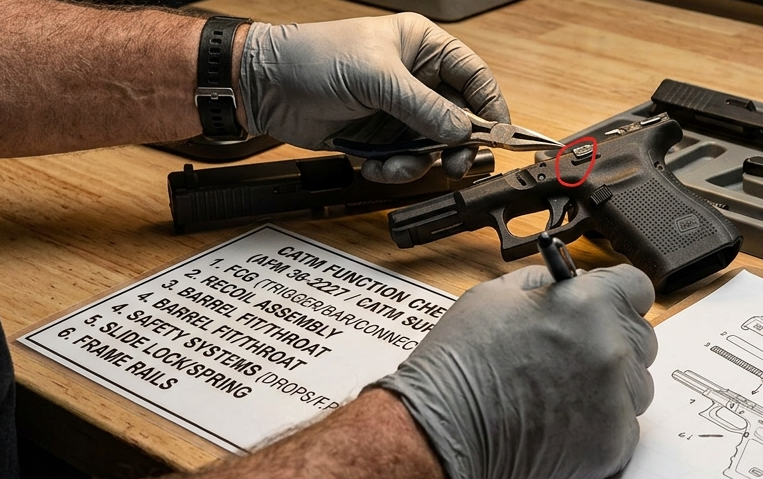
Last week a corrections officer brought me a Glock 23 Gen3. He had carried it as his duty weapon for 25 years. Cleaned it once. His complaint was a squishy trigger.
When I took the pistol I saw immediately that the slide locking bar and spring were missing. Not worn. Not cracked. Gone. He had no idea. Nobody had caught it. Not at qualification, not at the range, not by a department armorer.
I ordered parts. The gun will be fine. But that is not the point.
Where I came from, that case never reaches a gunsmith as a complaint. It gets caught on a scheduled firearm inspection, logged, and closed before the weapon goes back to service. The owner knows nothing about it because the system handles it before it becomes his problem.
That does not happen here. There is no system.
WHAT CATM ACTUALLY MEANS
Most people think of Combat Arms Training and Maintenance as a training program. Training is part of it. But the designation means something more specific: CATM instructors are the Air Force’s designated small arms subject matter experts. We owned the inventory.
Every weapon on the base was our responsibility. Qualification, yes. But also inspection cycles, sub-depot maintenance, serviceability documentation, and range safety. The job was not reactive. We ran scheduled inspections on a fixed cycle — every weapon examined on a timeline, not on complaint. If a pistol had not been inspected in 90 days, that was reason enough to pull it. Not because something felt wrong. Because time had passed.
"You do not inspect on complaint. You inspect because the weapon is in your hands and that is the only opportunity you will get."
If a weapon was out of spec, worn past tolerance, or missing a component, it was on us to find it before something happened. We documented everything. A weapon did not go back to service without a record showing it had been looked at and cleared by someone qualified to clear it.
That accountability is what a military firearms armorer lives inside every day. It is also what the civilian market has never built.
I carried that framework into civilian gunsmithing because nothing in six years has given me a reason to put it down.
WHY I DON’T TRUST THE COMPLAINT
Every firearm that comes to me gets a full function check before I touch whatever the customer asked about. Not because I doubt their description. Because the description covers what they noticed, and what they noticed is rarely the whole picture.
The G23 owner noticed a trigger he did not like. He did not notice the missing components because he did not know they existed. That is not unusual. Most owners do not know their firearm well enough to recognize when something is wrong unless the gun stops working entirely.
A pistol function check on a platform I know well takes maybe ten minutes. I go through the fire control group, recoil system, barrel fit and throat condition, magazine interface, and all safety systems. On a Glock that means checking the trigger bar, connector, firing pin safety, drop safety, and recoil spring assembly for wear and correct function. I check frame rails. I check the barrel for erosion at the feed ramp and throat. I look at the slide locking bar. I look at the spring.
I am looking for wear, for play that should not be there, for parts that are marginal or missing. I write down what I find.
On rifles the check expands: bolt carrier group, gas system, barrel extension, feed ramps, buffer system, handguard torque. The platform changes. The habit does not.
If I find something the customer did not ask about, I tell them. Every time. Some push back. They came in for a trigger job, not a lecture. I do the trigger job and I tell them anyway, and I put it in writing. What I found does not stop being a problem because they did not ask about it.
I have had people argue with me that their gun is fine. I show them what I found and explain what it means. Sometimes they listen. Sometimes they do not. Either way, they leave knowing.
That is the CATM habit applied to a civilian bench. You do not inspect on complaint. You inspect because the weapon is in your hands and that is the only opportunity you will get.
WHAT OWNERS GET WRONG
Most of the firearms that come through my door have one thing in common: the owner believes that if the gun still fires, it is fine.
That is not understanding the firearm. That is guessing.
"A firearm can be one missing part, one worn spring, one out-of-spec dimension away from a failure they never saw coming, and nothing about the way it shoots will tell them that. "
I hear it constantly. They have had it for years with no problems. They clean it once in a while. They put a few hundred rounds through it every year and it runs. What they do not understand is that a firearm can be one missing part, one worn spring, one out-of-spec dimension away from a failure they never saw coming, and nothing about the way it shoots will tell them that.
Duty pistol maintenance is not just about keeping the gun clean. It is about knowing the condition of the components that make it reliable under stress. A Glock running with a compromised recoil spring assembly will cycle fine until it does not. A worn trigger bar will function until it breaks. A missing slide locking bar and spring will not announce itself before the moment it matters.
The owner of that G23 carried a compromised duty weapon for years without knowing it. He is not careless. He is not negligent. He simply had no structure around him that would have caught it, and no relationship with a gunsmith who was going to look before he was asked.
WHAT I CANNOT FIX
The military inspection system worked because it was closed. Every weapon had a home, a record, a responsible party, and a cycle. Nobody opted out.
Civilian gunsmithing is the opposite. Most owners have no ongoing relationship with a smith. Most duty weapons, including those carried by corrections officers, security professionals, and armed civilians, move through their entire service life without a single professional firearm inspection.
I cannot fix that system. But I can run my bench a certain way.
The framework is transferable. Any smith who came out of military service already carries it. Inspect on schedule, not on complaint. Document what you find. Treat every firearm in your hands as your responsibility while it is there. That is a practice, not a credential. It does not require a CATM background to run. It requires the decision to do it consistently.
The G23 catch was not a difficult diagnosis. I knew what was wrong before the officer finished his sentence. Forty-three years of handling firearms gives you that pattern recognition fast. But the catch was not about skill. It was about looking in the first place.
"Most of the time, the problem is not what is broken. It is what nobody ever looked for."
Most of the time, the problem is not what is broken. It is what nobody ever looked for.