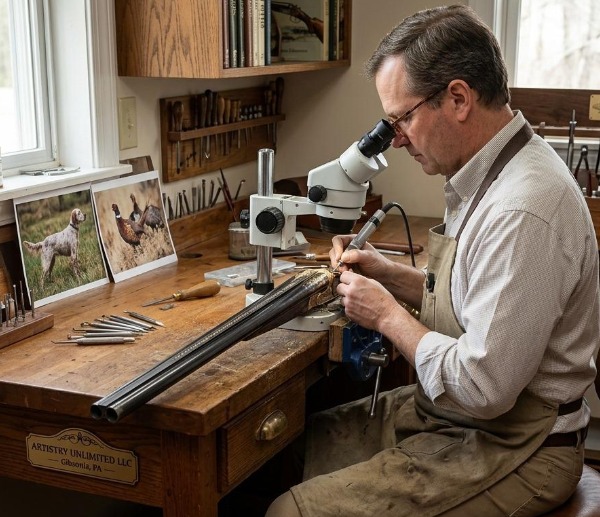
The most meaningful commission I've completed recently wasn't defined by the technical challenges, though those were real. It was defined by the relationship. The client knew what he wanted: his dogs on that gun, the birds he hunts every season, the life he's built around wing shooting. My job was to understand that well enough to make the steel speak for it.
The commission was a bespoke Parker a best gun in every sense, built by a stock maker and executed as well as both of us could. The client wanted the receiver to carry renditions of his personal dogs and the game birds he hunts. That's not just an aesthetic decision. It's an invitation to understand a man's connection to the field, his dogs, the whole world of wing shooting that's central to his life. Getting that right is what turns engraving into something personal.
The stock maker, Brian Dudley, and I worked almost entirely independent of each other. The client shared images of our respective progress between us throughout the project. When the gun came together at final assembly, the engraving on the receiver and the checkering on the stock read like one hand had done both. We didn't need constant coordination we were both working toward the same picture the client had given us, and that was enough.
"Understanding the man's bond with his dogs and his passion for wing shooting was the catalyst for transforming bare steel into art."
Every commission I take starts with that kind of listening. I welcome client involvement I encourage it. The more clearly I understand what a piece means to the person who commissioned it, the better I can realize it in the metal. I also bring fifteen years of knowing what translates to steel and what doesn't, and when something won't read the way the client has in mind, I say so and offer something that gets to the same place. The clients who stay engaged through the process and are comfortable letting the work take the time it needs are consistently the ones who end up with exactly what they wanted.
The Technical Side: Solving the Barrel Addresses
One of the more demanding parts of this commission was the barrel addresses. The gun is a Parker Reproduction with its own factory markings, and the client wanted those replaced with text that would read like original Peerless work from over a century ago. On a double gun, that's a specific technical problem.
Double-gun barrels are assembled with a rib soldered between the two tubes. The solders used typically flow somewhere between 350 and 800 degrees Fahrenheit. Conventional TIG or MIG welding generates heat that blows past that range at the work area, compromising the soldering and the barrel geometry. On a gun of this quality, any double gun, that's not acceptable.
I've worked with laser welders well over 20 years and personally owning one for over a decade. I use it regularly on antique, vintage, and collectible firearms. The beam works at 0.3 to 3 millimeters most of this work was done at 1 millimeter or below. The heat-affected zone is minimal. I hold the parts in my bare hands during the process. The solder stays put and the geometry holds. For work on double-gun barrels, it's the approach I rely on.
"Laser welding is an invaluable skill in restoring and preparing vintage, antique and collectible firearms. The precision makes possible things that simply can't be done any other way."
After filling the existing markings with the laser, I dressed the material down to a clean engraving surface. The working area was about a quarter inch wide by five inches long, bordered on both sides by machined wavy serrated patterns I couldn't touch. The original Peerless markings had run six and a half inches. My available space was five. I redesigned the lettering to fit the shorter field while keeping the period character the client wanted.
Then I did it all again for the second barrel set, because both sets were going into the same case side by side. Any visible difference between them would show immediately. Matching them to that standard takes the same focus on the second pass as the first — there's no easing up once you've set the target.
How It Ends
The client is completely happy with the gun — those are his words, and they're the ones that matter most to me. He’s commissioned several more projects before the piece even left the shop. That's what I'm working toward on every commission. Not just a satisfied client, but one whose connection to the piece keeps growing.
Most of my clients come back. They bring a new project on delivery of the last one, or they send a friend who saw the work and wants something similar. When someone sees a gun carrying another man's dogs and birds and says they want to do something like that for their own story, that's the craft doing what it should.
The projects that come out best are the ones where the client and I arrive at the same picture early and are both comfortable letting the work take the time it needs. That's how a piece becomes what it's supposed to be.